Principles, Operation, Design & Marine Application
Introduction
Two-stroke engines form the backbone of deep-sea propulsion.
From large container vessels and tankers to bulk carriers and LNG ships, slow-speed two-stroke diesel engines are trusted because they deliver:
- High efficiency
- Massive torque at low speed
- Continuous, reliable operation
- Excellent fuel economy for long voyages
This page explains how two-stroke marine engines work, why they are designed the way they are, and how engineers should think about them in operation.
📌 Scope note
This page explains principles, design logic, and operation.
Component overhauls, faults, tuning, emissions, and calculations are covered in their dedicated system pages.
Contents
- What Defines a Two-Stroke Marine Engine?
- Why Two-Stroke Engines Dominate Main Propulsion
- The Two-Stroke Operating Cycle (Step by Step)
- Scavenging: The Heart of the Two-Stroke Engine
- Air Supply & Turbocharging
- Fuel Injection & Combustion
- Lubrication Philosophy in Two-Stroke Engines
- Cooling & Thermal Control
- Mechanical Design Features
- Control, Monitoring & Protection
- Operational Characteristics at Sea
- Common Misconceptions About Two-Stroke Engines
- How This Page Connects to the Rest of the Engine Room
1. What Defines a Two-Stroke Marine Engine?
A two-stroke marine engine completes a full operating cycle in one crankshaft revolution.
This means:
- One power stroke every revolution
- No separate intake or exhaust strokes
- Gas exchange happens through ports in the cylinder liner
Key defining characteristics:
- Slow rotational speed (typically 60–120 RPM)
- Large bore, long stroke
- Direct coupling to the propeller
- Uniflow scavenging
- Continuous-duty operation
⚙️ “Two-stroke” refers to the cycle — not simplicity.
2. Why Two-Stroke Engines Dominate Main Propulsion
Two-stroke engines are chosen not because they are old — but because they are optimal for marine propulsion.
Key advantages
- High thermal efficiency
- Excellent fuel economy
- High torque at low RPM
- No reduction gearbox required
- Simpler power transmission
- Better propeller efficiency
Marine reality
Ships require:
- Continuous thrust
- Predictable response
- Long maintenance intervals
- Operation far from shore support
Two-stroke engines are built around these realities.
3. The Two-Stroke Operating Cycle (Step by Step)
Unlike four-stroke engines, all major events occur within one piston movement up and down.
Upward Stroke (Compression)
- Exhaust valve closes
- Fresh air is trapped in the cylinder
- Air is compressed to high pressure and temperature
Fuel Injection & Combustion
- Fuel is injected near TDC
- Self-ignition occurs
- Combustion pushes piston downward
Downward Stroke (Power + Gas Exchange)
- Exhaust valve opens
- Exhaust gases begin to leave
- Scavenge ports open
- Fresh air enters, pushing exhaust out
- Cycle repeats
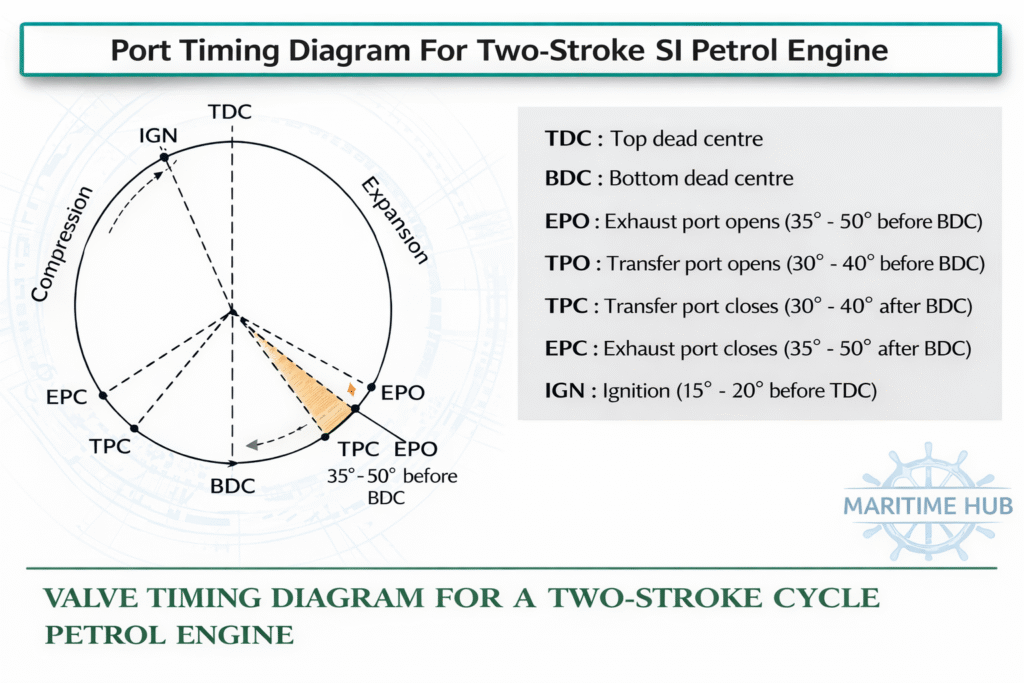
4. Scavenging: The Heart of the Two-Stroke Engine
Scavenging is the process of:
- Removing exhaust gases
- Replacing them with fresh air
- Without mixing excessively
Uniflow scavenging (marine standard)
- Air enters through liner ports
- Exhaust exits via cylinder head valve
- Gas flow is one-directional
Benefits:
- Efficient gas exchange
- Better combustion
- Reduced thermal stress
- Improved emissions performance
📌 Scavenging faults affect power, temperatures, fuel consumption, and emissions.
5. Air Supply & Turbocharging
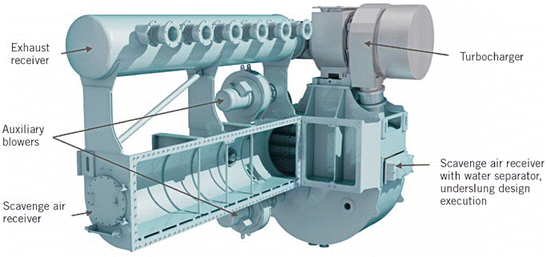
Two-stroke engines cannot draw in air naturally.
They rely entirely on:
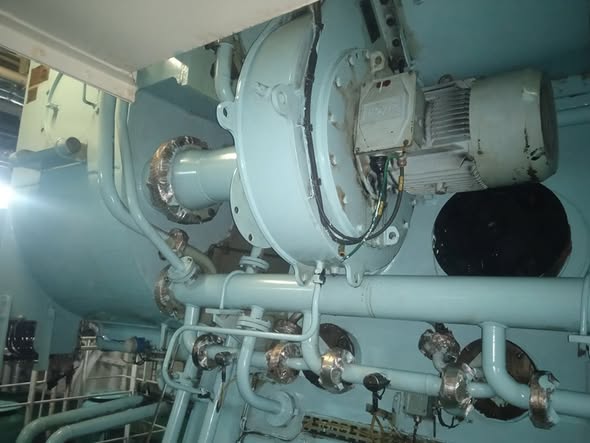
- Turbochargers
- Scavenge air receivers
- Auxiliary blowers (low load)
Why turbocharging is essential
- Provides scavenge air pressure
- Ensures cylinder filling
- Maintains combustion stability
At low loads:
- Auxiliary blowers support airflow
- Turbocharger efficiency is reduced
6. Fuel Injection & Combustion
Two-stroke engines use high-pressure, timed fuel injection.
Key principles:
- Injection occurs over a short crank angle
- Fuel atomisation is critical
- Combustion must be controlled, not explosive
Combustion quality depends on:
- Injection timing
- Fuel quality
- Scavenge air temperature
- Compression pressure
⚠️ Poor combustion leads to:
- High exhaust temperatures
- Piston crown damage
- Liner wear
- Emissions issues
7. Lubrication Philosophy in Two-Stroke Engines
Unlike four-stroke engines, lubrication is divided by function.
Main lubrication systems
- System oil (bearings, crankcase)
- Cylinder oil (liner & rings)
Cylinder oil:
- Is injected directly
- Is partially consumed
- Neutralises sulphur acids
- Protects liner surfaces
📌 Cylinder lubrication strategy is critical and fuel-dependent.
8. Cooling & Thermal Control
Two-stroke engines operate under extreme thermal loads.
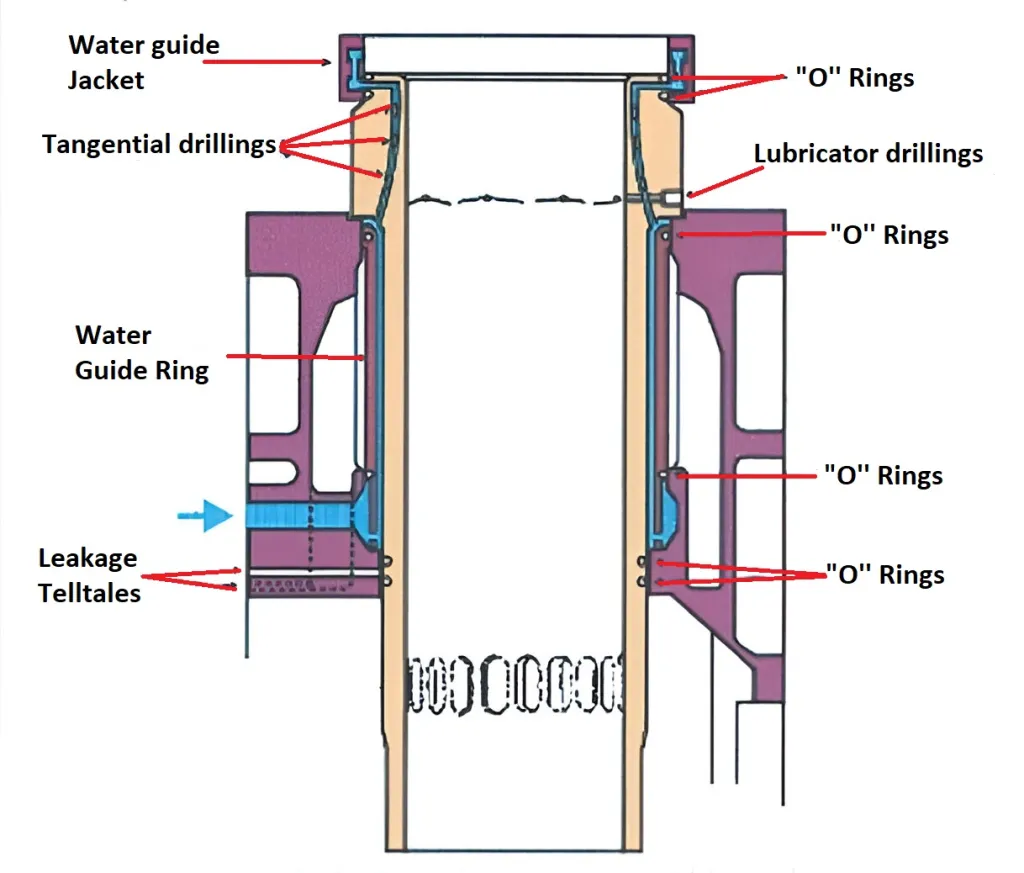
Cooling is applied to:
- Cylinder liners
- Cylinder covers
- Exhaust valves
- Pistons
Design priorities:
- Prevent thermal cracking
- Control metal temperatures
- Maintain material strength
9. Mechanical Design Features
Two-stroke engines are built for strength and longevity.
Typical features:
- Crosshead design
- Long connecting rods
- Separate crankcase and cylinder spaces
- Heavy bedplate and frame box
Benefits:
- Reduced side thrust
- Improved liner life
- Easier maintenance access
- Better oil control
10. Control, Monitoring & Protection
Modern two-stroke engines use:
- Electronic governors
- Cylinder pressure monitoring
- Exhaust temperature monitoring
- Safety shutdowns
Critical monitored parameters:
- Exhaust temperatures
- Scavenge air pressure
- Lubrication flow
- Bearing temperatures
⚠️ Alarms indicate deviation from normal, not failure itself.
11. Operational Characteristics at Sea
Two-stroke engines:
- Respond slowly to load changes
- Prefer steady operation
- Require careful manoeuvring control
- Are sensitive to fuel quality
Engineers must understand:
- Load limits
- Thermal stabilisation time
- Slow steaming effects
- Minimum load constraints
12. Common Misconceptions About Two-Stroke Engines
❌ “Two-stroke engines are simpler”
✔ They are conceptually simpler but mechanically massive
❌ “They are outdated technology”
✔ They are continuously evolving
❌ “They are inefficient”
✔ They are among the most efficient heat engines ever built
13. How This Page Connects to the Rest of the Engine Room
This page is the conceptual anchor for:
- Fuel systems
- Lubrication systems
- Starting & reversing
- Performance & tuning
- Emissions control
- Fault diagnosis
📌 If a problem exists on a two-stroke engine, it always traces back to principles explained here.
Tags
two-stroke marine engine · slow speed diesel · main engine propulsion · marine engineering training · engine room fundamentals
Next logical steps (recommended)
From here, users should move to:
- Fuel Injection Systems
- Scavenging & Air Systems
- Starting & Reversing
- Performance & Tuning
- Common Two-Stroke Faults