Contents
Use the links below to jump to any section:
- What Is a Marine Engine?
- Energy Conversion at Sea
- Basic Engine Components (Concept Level)
- What Is an Engine Cycle?
- The Four Fundamental Strokes
- Two-Stroke vs Four-Stroke: Conceptual Differences
- Thermodynamic Cycles Explained Simply
- Why Marine Engines Are Different from Automotive Engines
- Supporting Systems: The Bigger Picture
- Operational Mindset for Marine Engineers
- How to Use This Section Going Forward
1. What Is a Marine Engine?
At its simplest level, a marine engine is a machine that converts fuel energy into mechanical work.
That work is then used to:
- Turn a propeller
- Drive generators
- Power pumps, compressors, and/or auxiliaries
Unlike land-based engines, marine engines must:
- Operate continuously for long periods
- Handle variable loads
- Remain reliable in isolated environments
- Be maintained and repaired by the onboard engineers
2. Energy Conversion at Sea
All marine engines follow the same energy path:
→ Chemical Energy (Fuel)
→ Thermal Energy (Combustion)
→ Mechanical Energy (Rotation)
→ Useful Work (Propulsion / Power)
Key ideas:
- Engines do not create energy — they convert it
- Losses occur as heat, friction, vibration, noise
- Efficiency is about maximising useful output while minimising losses
🔧 This is why cooling, lubrication, and exhaust systems are just as important as combustion itself.
3. Basic Engine Components (Concept Level)
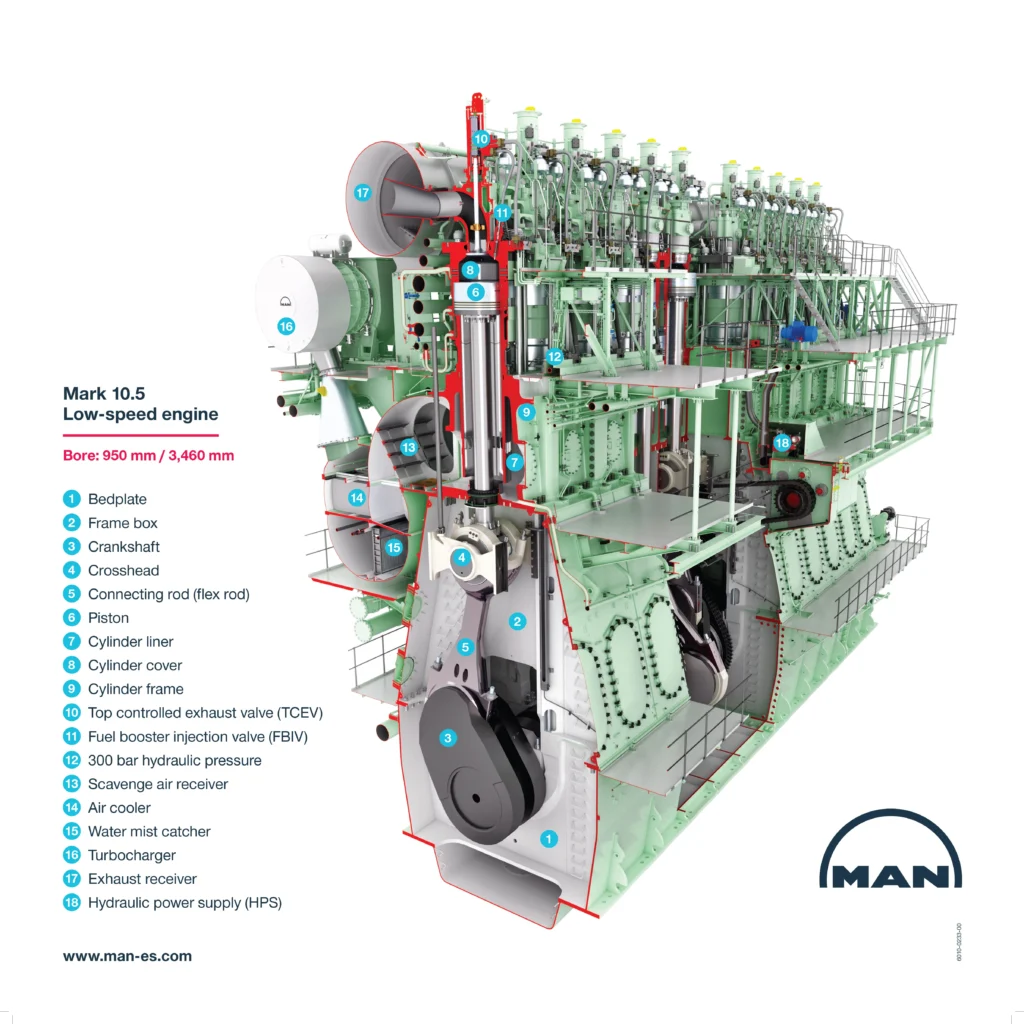
This section introduces components by function, not design detail.
Core mechanical elements
- Cylinder
- Piston
- Connecting rod
- Crankshaft
- Bearings
Combustion elements
- Fuel injector
- Air inlet
- Exhaust outlet
- Combustion chamber
Control & protection
- Governors
- Sensors
- Alarms
- Shutdown systems
📌 Detailed construction differences are covered in:
- Two-Stroke
- Four-Stroke
- Dual-Fuel
- Electric / Hybrid
4. What Is an Engine Cycle?
An engine cycle is the complete sequence of events required to:
- Draw in air
- Compress it
- Add fuel
- Release energy
- Remove exhaust gases
A cycle always returns the engine to its starting condition, ready to repeat.
Cycles are defined by:
- Number of strokes
- Timing of combustion
- Gas exchange method
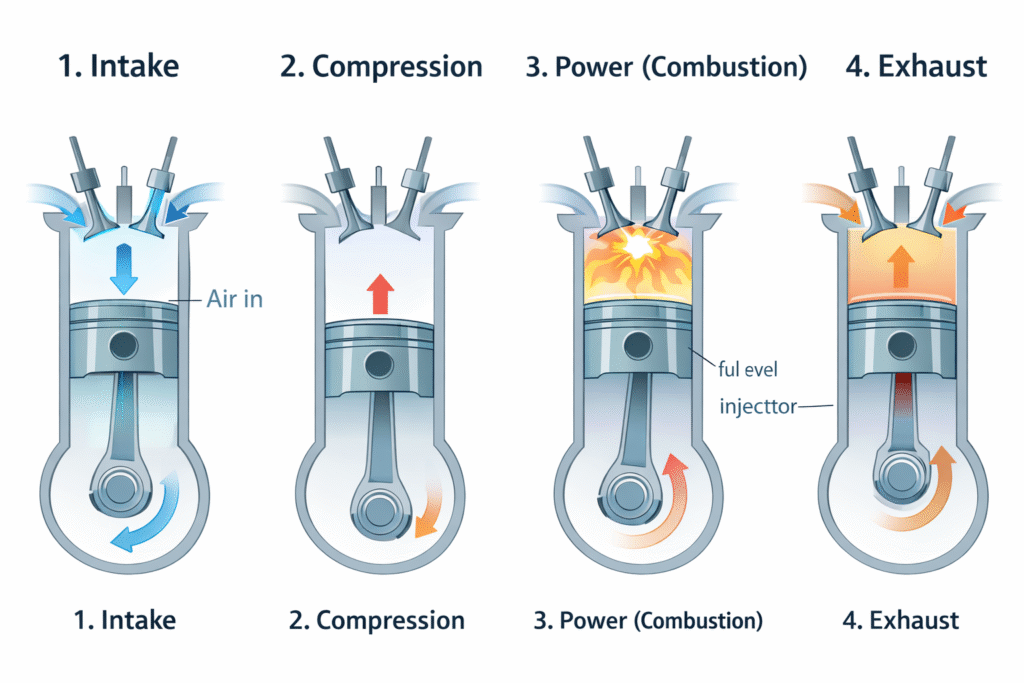
5. The Four Fundamental Strokes
All reciprocating internal combustion engines rely on these four actions — even if they are combined differently.
1. Intake
Air enters the cylinder.
2. Compression
Air is compressed, increasing temperature and pressure.
3. Power (Combustion)
Fuel is injected and ignites, forcing the piston down.
4. Exhaust
Burnt gases are expelled.
6. Two-Stroke vs Four-Stroke: Conceptual Differences
This section explains why designs differ, not how to overhaul them.
Two-Stroke
- Power every crankshaft revolution
- Combined intake/exhaust process
- Larger, slower-speed engines
- Common in main propulsion – like the famous slow speed diesel engines
Four-Stroke
- Power every second revolution
- Separate intake and exhaust strokes
- Higher speeds
- Common in auxiliaries and generators
7. Thermodynamic Cycles Explained Simply
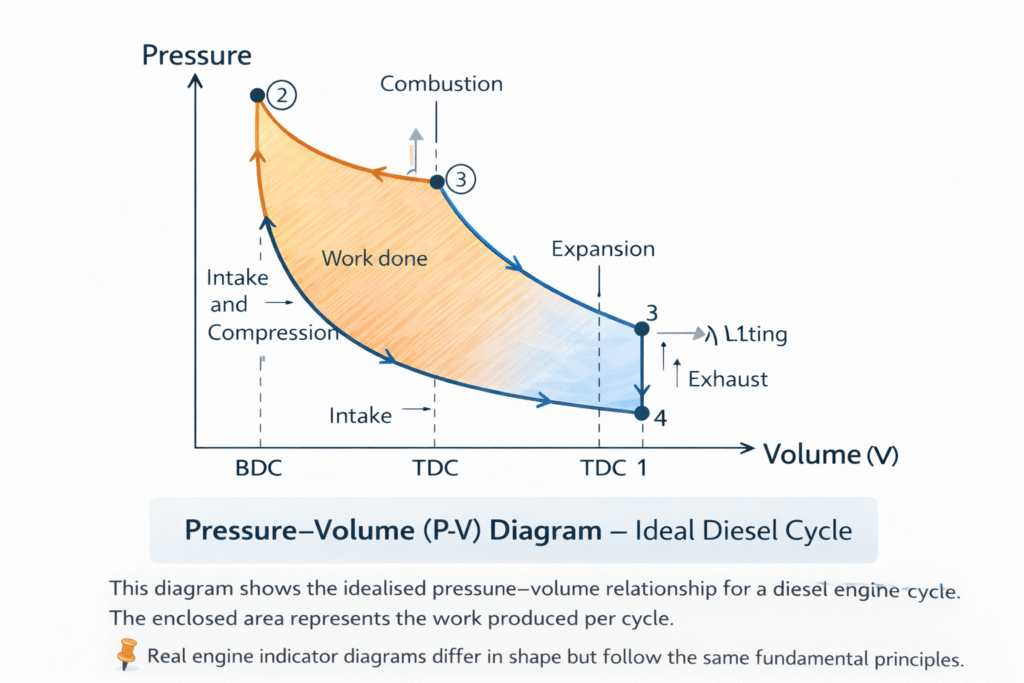
Marine engines are based on idealised thermodynamic cycles.
Diesel Cycle (Most marine engines)
- Combustion at near-constant pressure
- High compression ratios
- Self-ignition (no spark)
Otto Cycle
- Constant volume combustion
- Spark ignition
- Mainly automotive / gas engines
Dual-Fuel Variations
- Blend of diesel pilot and gaseous fuel
- Cycle behaviour changes depending on mode
8. Why Marine Engines Are Different from Automotive Engines
Marine engines are designed for:
- Longevity over speed
- Serviceability over compactness
- Redundancy over optimisation
Key differences:
- Lower RPM
- Heavier construction
- Continuous operation
- Manual control capability
- On-board maintenance philosophy
⚠️ At sea, reliability is safety.
9. Supporting Systems: The Bigger Picture
An engine cannot operate alone.
Every cycle depends on supporting systems working correctly:
- Fuel supply & treatment
- Lubrication
- Cooling (LT / HT)
- Air supply & exhaust
- Control & monitoring
- Starting systems
📌 Each system has its own dedicated section in the side menu to prevent overlap.
10. Operational Mindset for Marine Engineers
Understanding fundamentals builds the correct mindset:
- Symptoms rarely originate where they appear
- Systems interact — faults propagate
- Engines respond to load, temperature, and fuel quality
- Alarms are indicators, not problems themselves
This mindset is essential for:
- Watchkeeping
- Fault diagnosis
- Safe operation
- Mentoring junior crew
11. How to Use This Section Going Forward
This page is your reference anchor.
Recommended learning path:
- Read Fundamentals & Cycles
- Move to specific engine types
- Study systems individually
- Apply knowledge through troubleshooting guides
- Use calculators and data sheets when operational
🎓 Return to this page whenever a concept feels unclear — fundamentals never change.
Tags
marine engineering fundamentals · engine cycles · diesel engines · cadet training · engine room basics