Control, Compliance, Proof & Operational Memory
Introduction
Shipboard documentation is not bureaucracy for its own sake.
It is legal authority, operational evidence, safety memory, and liability protection.
Every certificate, logbook, checklist, and form exists for one of four reasons:
- To prove the ship is legally allowed to trade
- To demonstrate compliance at the moment of inspection
- To ensure safe and repeatable operations
- To provide traceability after incidents or accidents
From a Chief Engineer or Master’s perspective, documentation is a control system — poorly managed paperwork is a latent casualty.
Modern vessels now operate with a hybrid documentation model:
- Statutory certificates (paper + electronic)
- Operational logs (paper or electronic record books)
- Forms, permits, and checklists integrated into the SMS
1. Core Categories of Shipboard Documentation
Ship documentation can be reduced into six functional groups:
1. Statutory Certificates (Legal Right to Operate)
Issued by or on behalf of the Flag State under international conventions.
Typical examples:
- SOLAS Safety Certificates (Construction, Equipment, Radio)
- MARPOL Certificates (IOPP, IAPP, ISPP, IEEC)
- Load Line Certificate
- Tonnage Certificate
- International Ship Security Certificate (ISSC)
- Safety Management Certificate (SMC)
- Maritime Labour Certificate (MLC)
Key principle:
If a statutory certificate is invalid or missing → the ship is legally unseaworthy, regardless of physical condition.
2. Classification & Technical Certificates
Issued by Classification Societies (often also acting as Recognized Organizations).
Examples:
- Certificate of Classification
- Survey Status & Memoranda
- Machinery, hull, and system approval documents
- Enhanced Survey Programme (ESP) files (bulk carriers, tankers)
These documents prove:
- Structural integrity
- Machinery compliance
- Maintenance regimes
3. Operational & Log Records
These are evidence of how the ship is actually run.
Typical records:
- Engine Room Log Book
- Deck Log Book
- Oil Record Book (Parts I & II)
- Garbage Record Book
- Ballast Water Record Book
- Fuel Changeover Log
- NOx Engine Parameter Record
- PMS records (planned maintenance)
Increasingly accepted as electronic record books, provided they comply with IMO / MARPOL guidelines.
4. Crew & Manning Documentation
Defines who is allowed to be onboard and in what role.
Includes:
- Certificates of Competency (STCW)
- Endorsements
- Medical certificates
- Safe Manning Document
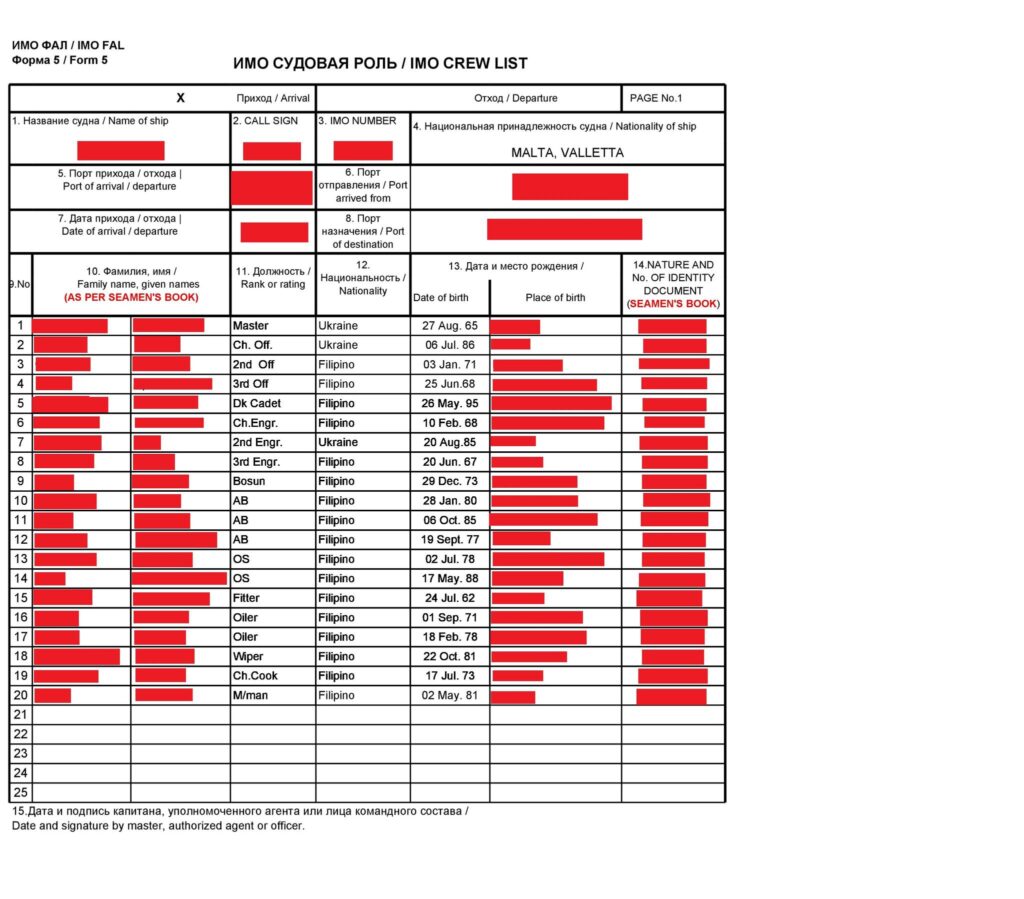
- Crew List
- Watchkeeping schedules
Failure here is a direct PSC detention risk.
5. Cargo & Voyage Documents
Required for trade, customs, and port clearance.
Includes:
- Bills of Lading
- Sea Waybills
- Cargo Manifests
- Dangerous Goods Declarations
- Grain / Chemical / Gas Certificates of Fitness
- Cargo Securing Manual
- Stability Booklets
6. Forms, Checklists & SMS Records
These are control documents, not certificates.
Examples:
- Permit to Work (PTW)
- Risk Assessments
- Toolbox Talks
- Drill records
- Emergency checklists
- Audit checklists
- Non-conformity & corrective action reports
These documents protect the crew and the company, especially after incidents.
2. FAL Forms – Port Entry & Clearance
Under the IMO Facilitation (FAL) Convention, ports are required to accept standardized declarations, increasingly in electronic format.
Standard FAL Declarations (Arrival & Departure)
| FAL No. | Declaration |
|---|---|
| FAL 1 | General Declaration |
| FAL 2 | Cargo Declaration |
| FAL 3 | Ship’s Stores Declaration |
| FAL 4 | Crew’s Effects Declaration |
| FAL 5 | Crew List |
| FAL 6 | Passenger List |
| FAL 7 | Dangerous Goods Manifest |
Additional requirements may include:
- Maritime Declaration of Health
- Ship Sanitation Certificate
- Security information (ISPS)
- Advance waste delivery notification
Operational note:
Even with electronic submission, ships must retain verification instructions onboard.
3. Electronic Certificates & Record Books
Electronic Certificates (e-Certificates)
IMO formally recognizes electronic certificates as equivalent to paper if they meet verification requirements.
Key requirements:
- Unique tracking number
- Secure verification method (QR, database, URL)
- Electronic signature
- Protection against modification
- Continuous availability for PSC
If verification fails → certificate is treated as missing.
Electronic Record Books (MARPOL)
Approved electronic systems may replace paper books for:
- Oil Record Book
- Garbage Record Book
- Cargo Record Book
- ODS Record Book
- Fuel Changeover Log
- NOx Engine Records
Mandatory system features:
- Role-based access control
- Audit logging (who entered, amended, verified)
- Secure amendment traceability
- Master verification function
- Offline backup capability
- Printable certified copies
Engineering reality:
Electronic logs do not reduce responsibility — they increase traceability.
4. Master List of Documents (MLOD)
Every vessel should maintain a Master List of Documents, showing:
- Document name
- Issuing authority
- Location onboard
- Validity / renewal date
- Responsible officer
This is the first document PSC inspectors mentally reconstruct, even if not formally requested.
5. Forms & Checklists – Operational Control Layer
Forms and checklists are not administrative clutter — they are accident prevention tools.
Common Shipboard Forms
- Permit to Work (hot work, enclosed space, electrical isolation)
- Risk Assessments
- Lock-out / Tag-out forms
- Maintenance requests
- Engine changeover checklists
- Pre-departure checklists
- Emergency response checklists
- Audit & inspection checklists
Why They Matter
- Ensure procedural discipline
- Reduce human error
- Provide legal defense
- Standardize operations across crews
- Demonstrate SMS effectiveness
A missing checklist after an incident is often interpreted as negligence, not oversight.
6. Best Practice for Managing Documentation Onboard
From an operational standpoint:
- Keep statutory certificates immediately accessible
- Maintain a clear paper/electronic boundary
- Verify electronic certificate access before arrival
- Back up electronic records offline
- Train crew on why forms exist, not just how to fill them
- Review emergency checklists after drills
- Never back-fill logs unless explicitly permitted
7. Consequences of Poor Documentation Control
Poor documentation leads to:
- Port State Control detention
- Delayed departures
- Insurance disputes
- Criminal exposure (especially MARPOL)
- Crew certification challenges
- Loss of charter confidence
In serious cases, documentation failures outlive the ship in court records.
Summary
Shipboard documentation is:
- A legal shield
- A safety system
- An operational memory
- A compliance instrument
Well-run ships treat documentation as engineering discipline, not paperwork.