Transient Thrust, Hydraulic Reality, and the Hidden Load on the Power Plant
ENGINE ROOM → Propulsion & Transmission
System Group: Manoeuvring & Position Control
Primary Role: Lateral thrust for low-speed manoeuvring and station keeping
Interfaces: Electrical Power · Hydraulic Systems · Control Systems · Hull Structure
Operational Criticality: Intermittent but High Impact
Failure Consequence: Loss of manoeuvrability → collision risk → port state intervention
Thrusters are not auxiliary conveniences.
They are high-load propulsion machines operating under the least favourable hydrodynamic conditions.
Position in the Plant
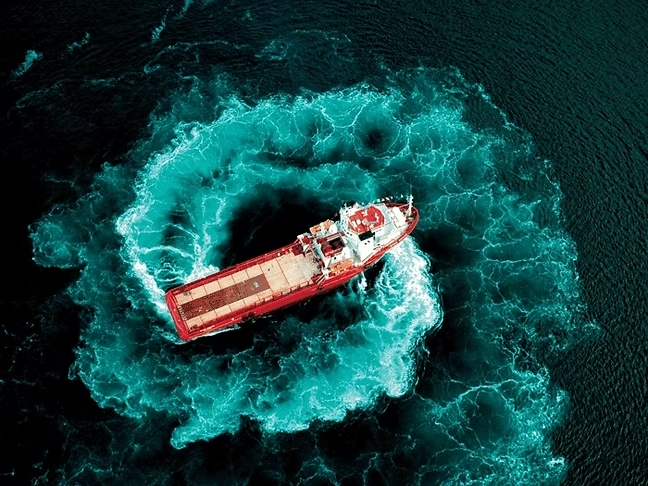
Thrusters operate at low vessel speed, where water flow is poor, turbulence is high, and power demand spikes abruptly. They impose severe transient loads on electrical and hydraulic systems while providing minimal hydrodynamic efficiency.
From an engineering perspective, thrusters are shock loads, not steady machines. Their impact on generators, switchboards, and cooling systems is disproportionate to their apparent size.
Contents
Thruster Purpose and Design Intent
Tunnel vs Azimuth Thruster Architecture
Hydrodynamics at Zero Speed
Drive Systems: Electric and Hydraulic
Control, Interlocks, and Power Limitation
Thermal and Structural Loading
Failure Development and Damage Progression
Human Oversight and Engineering Judgement
1. Thruster Purpose and Design Intent
Thrusters exist to provide controlled lateral force during:
- harbour manoeuvring
- low-speed approach
- dynamic positioning
- emergency avoidance
They are not designed for continuous operation at maximum thrust. The design intent is short-duration, high-impact force, not sustained propulsion.
Exceeding this intent does not trip alarms immediately. It accelerates wear invisibly.
2. Tunnel vs Azimuth Thruster Architecture
Tunnel Thrusters
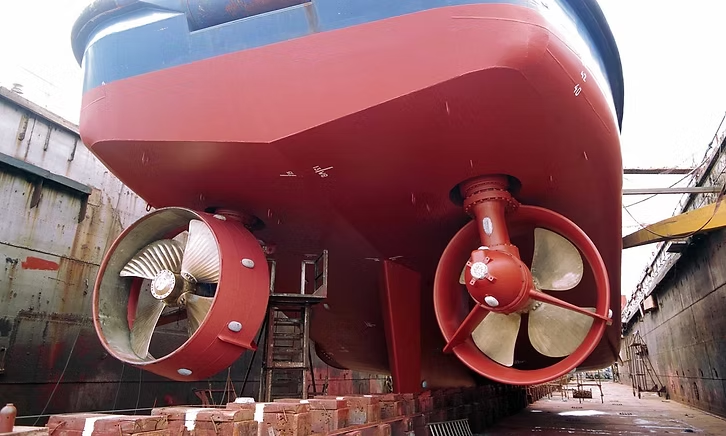
Tunnel thrusters operate within a fixed transverse tunnel through the hull.
They suffer from:
- poor inflow conditions
- recirculation
- interaction with hull boundary layers
Efficiency collapses rapidly with vessel speed. Prolonged operation results in heating, vibration, and structural fatigue.
Azimuth Thrusters
Azimuth thrusters rotate to vector thrust direction.
They offer superior control but introduce:
- complex gearboxes
- slewing bearings
- seal and cable management challenges
Mechanical complexity replaces hydrodynamic inefficiency.
3. Hydrodynamics at Zero Speed
Thrusters operate in aerated, turbulent water.
Cavitation is common. Ventilation is frequent. Thrust fluctuates rapidly.
These conditions impose:
- cyclic torque
- blade vibration
- fluctuating electrical load
Thruster damage is often attributed to “hard use”. In reality, it is a consequence of physics operating at the edge of design limits.
4. Drive Systems: Electric and Hydraulic
Electric Thrusters
Electric drives impose immediate load on the power system.
Failure risks include:
- voltage dip
- generator overload
- overheating during repeated starts
Hydraulic Thrusters
Hydraulic systems buffer electrical load but introduce thermal and contamination risks.
Hydraulic thrusters fail quietly through:
- oil overheating
- seal degradation
- pressure instability
Neither system is forgiving of abuse.
5. Control, Interlocks, and Power Limitation
Thruster control systems exist to limit damage, not optimise performance.
Interlocks may include:
- generator availability
- thermal limits
- time-based cut-outs
Bypassing interlocks does not increase capability. It accelerates failure.
6. Thermal and Structural Loading
Thruster motors and gearboxes are thermally constrained.
Repeated short operations can be more damaging than a single long run. Heat accumulates internally while cooling remains marginal due to low water flow.
Structural loading transfers into the hull locally, contributing to cracking around tunnels and foundations.
7. Failure Development and Damage Progression
Thruster failures progress through:
- blade erosion and imbalance
- bearing distress
- seal leakage
- motor insulation degradation
Loss of thrust often occurs suddenly, after extended unnoticed deterioration.
8. Human Oversight and Engineering Judgement
Thrusters invite misuse.
Engineers protect them by:
- limiting duty cycles
- monitoring thermal behaviour
- coordinating with bridge teams
A thruster that “still responds” may already be structurally compromised.
Relationship to Adjacent Systems and Cascading Effects
Thruster operation directly affects:
- electrical stability
- hydraulic cooling demand
- hull integrity
- port safety outcomes
A failed thruster is rarely an isolated inconvenience.