Principles, Systems, Sequences, Safeties, and Practical Engine-Room Reality
Meta Description: A complete marine engineering guide to starting and reversing ship engines: air start systems, control logic, interlocks, slow-turning, reversing methods for two-stroke, four-stroke, diesel-electric, and hybrid propulsion.
Tags: engine starting, reversing, air start system, starting air, manoeuvring, bridge control, engine safety, turning gear, slow turning, ahead astern
Introduction
Starting and reversing are the most safety-critical transient operations any marine propulsion system performs.
At sea, engines spend most of their life running steadily.
But starting, stopping, and reversing occur:
- In confined waters
- Close to hazards
- Under time pressure
- Often with cold machinery
- Frequently with non-ideal loads
This is why starting and reversing systems are heavily interlocked, sequenced, and protected — and why engineers must understand what happens, not just which button to press.
This page is the single reference point for:
- How marine engines are started
- How direction is changed
- Why systems are designed the way they are
- What commonly goes wrong
- How different engine types handle the same task differently
Contents
- 1. Why Starting & Reversing Matter
- 2. Core Principles (Common to All Engines)
- 3. Starting Systems Overview
- 4. Starting Air Systems (Deep Dive)
- 5. Two-Stroke Engine Starting & Reversing
- 6. Four-Stroke Engine Starting & Reversing
- 7. Diesel-Electric & Hybrid Starting Logic
- 8. Bridge Control, ECR Control & Local Control
- 9. Safeties, Interlocks & Permissives
- 10. Typical Faults & Troubleshooting Patterns
- 11. Operational Best Practice at Sea
- 12. Common Misconceptions
- 13. How This Links to Other ENGINE Topics
1) Why Starting & Reversing Matter
From an engineering perspective, starting and reversing are transient states — and transients create stress.
During these moments:
- Lubrication is not fully established
- Clearances are changing rapidly
- Combustion quality is unstable
- Load may be applied suddenly
- Human reaction time matters
Most serious engine damage incidents occur:
- Immediately after start
- During manoeuvring
- During crash stops or repeated reversals
That’s why marine engines use compressed air, sequenced fuel admission, slow-turning, and multiple layers of interlocks.
2) Core Principles (Common to All Marine Engines)
Regardless of engine type, every marine starting system must achieve four things:
- Rotate the engine from rest
- Establish lubrication before firing
- Introduce fuel at the correct moment
- Allow controlled acceleration to idle
Reversing adds a fifth requirement:
- Change torque direction without mechanical damage
This is achieved differently depending on engine design — but the principles never change.
3) Starting Systems Overview
Main starting methods used at sea
- Compressed air starting (large engines)
- Electric motor starting (small/medium engines)
- Hydraulic starting (specialist applications)
For main propulsion engines, compressed air remains dominant because:
- It delivers very high torque instantly
- It does not rely on electrical power during blackout
- It allows repeated starts in short succession
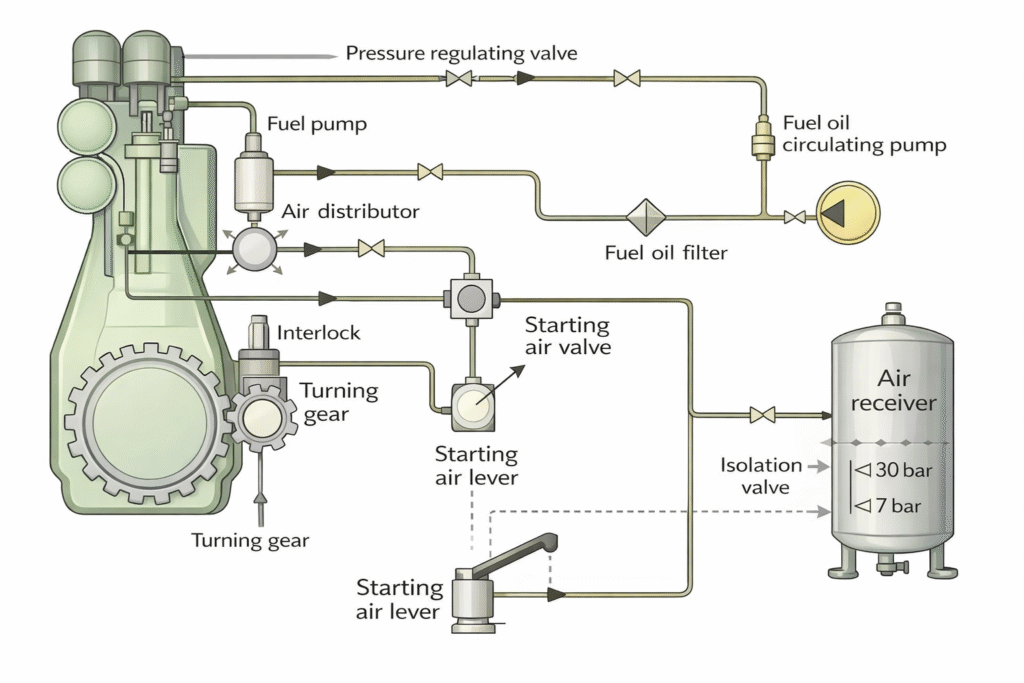
4) Starting Air Systems
4.1 System components
A typical starting air system consists of:
- Air compressors
- Starting air receivers (bottles)
- Non-return valves
- Starting air distributor
- Cylinder starting air valves
- Control air system
- Flame arrestors and relief devices
4.2 Why air is used instead of fuel
Fuel ignition requires:
- Adequate compression temperature
- Correct injection timing
- Stable rotational speed
Compressed air:
- Spins the engine regardless of temperature
- Clears cylinders of residual gases
- Ensures oil pressure builds before firing
4.3 Air admission sequence
Air is admitted:
- In the direction of intended rotation
- To cylinders near TDC
- In a timed sequence controlled by the distributor
Once the engine reaches firing speed:
- Starting air cuts off
- Fuel is admitted
- Engine becomes self-sustaining
5) Two-Stroke Engine Starting & Reversing
5.1 Two-stroke starting sequence
- Turning gear disengaged
- Pre-lube complete
- Indicator cocks open (initial start)
- Start command given
- Starting air distributor aligns
- Air admitted to selected cylinders
- Engine rotates to firing speed
- Fuel admitted
- Air cut-off
- Engine stabilises at manoeuvring RPM
5.2 Reversing a two-stroke engine
Reversing is achieved by changing valve and fuel timing, not by reversing a gearbox.
Key actions:
- Exhaust valve timing shifts
- Fuel injection timing shifts
- Starting air distributor switches to opposite direction
The engine is effectively re-timed to run backwards.
This is why two-stroke engines:
- Can reverse without gearboxes
- Are ideal for large slow-speed propulsion

6) Four-Stroke Engine Starting & Reversing
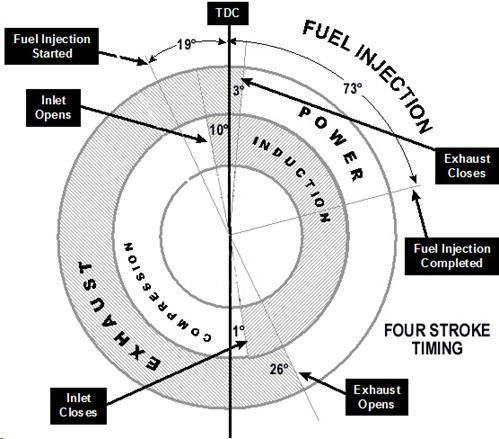
6.1 Four-stroke starting
Four-stroke engines typically:
- Start using electric or air-assisted systems
- Fire at much lower torque than two-strokes
- Reach idle speed rapidly
6.2 Reversing in four-stroke systems
Four-stroke engines do not reverse direction internally.
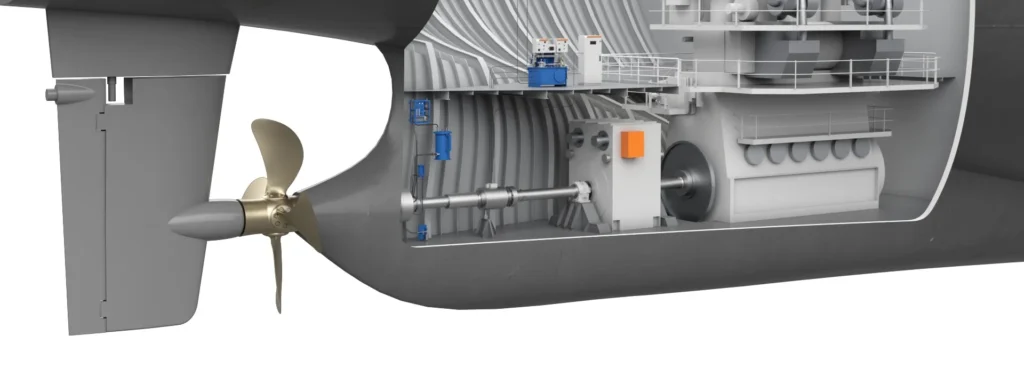
Reversing is achieved by:
- Reversible gearboxes
- Controllable Pitch Propellers (CPP)
Engine direction remains constant.
This simplifies engine design but:
- Adds mechanical complexity elsewhere
- Introduces gearbox and pitch control systems
7) Diesel-Electric & Hybrid Starting Logic
7.1 Diesel-electric propulsion
There is no engine reversing.
Process:
- Gensets start and synchronise
- Electrical power supplied to propulsion motors
- Motor direction is controlled electrically
Reversing is:
- Instant
- Smooth
- Limited by motor and drive protection
7.2 Hybrid systems
Hybrid systems add complexity:
- Engine start logic
- Battery SOC limits
- Mode selection (electric / mechanical / combined)
Reversing logic must coordinate:
- Propulsion motor direction
- Shaft line torque
- Engine clutch or PTI/PTO status
8) Bridge Control, ECR Control & Local Control
Control hierarchy
- Local control – direct engine control (maintenance/emergency)
- ECR control – normal manoeuvring authority
- Bridge control – navigational command
Only one station may have control at a time.
Transfer of control requires:
- RPM at zero
- Confirmation of command
- Interlock satisfaction

9) Safeties, Interlocks & Permissives
Common start permissives
- Turning gear disengaged
- Adequate starting air pressure
- Lube oil pressure available
- No critical alarms active
- Correct control station selected
Common reverse protections
- RPM below limit
- Fuel cut-off before direction change
- Pitch at zero (CPP systems)
These systems exist to protect machinery from human error.
10) Typical Faults & Troubleshooting Patterns
Engine does not start
- No starting air pressure
- Distributor not shifting
- Turning gear interlock active
- Control air failure
Engine starts then dies
- Fuel admission failure
- Incorrect timing
- Low lube oil pressure trip
Reversing failure
- Distributor stuck
- Control air leak
- CPP feedback mismatch
11) Operational Best Practice at Sea
Good engineers:
- Avoid repeated crash starts
- Allow stabilisation between reversals
- Monitor air consumption
- Respect warm-up requirements
- Understand automation — not fight it
12) Common Misconceptions
❌ “Starting air is only for emergencies”
✔ It is the primary starting method for large engines
❌ “Electric ships don’t need starting procedures”
✔ They still rely on PMS logic and protection sequencing
❌ “Reversing is instant”
✔ Only if systems are healthy and limits are respected
13) How This Links to Other ENGINE Topics
This page connects directly to:
- Two-Stroke Engines → air start & reversing timing
- Four-Stroke Engines → CPP & gearbox operation
- Hybrid/Electric Propulsion → motor direction control
- Control & Automation → PMS, interlocks, safety logic
- Faults & Troubleshooting → start failures, manoeuvring alarms
It is a core foundation page for the entire ENGINE section.