Principles, Operation, Design & Marine Application
Engine Room · Core Machinery · Thermal Power Systems
Introduction
Steam turbines are one of the most enduring and powerful prime movers ever deployed at sea. While often regarded as legacy technology, they remain operationally critical in modern maritime engineering—particularly in high-power, high-reliability, and fuel-flexible applications.
From naval vessels and LNG carriers to turbo-generators and cargo pumping systems, steam turbines continue to prove their value through:
- Smooth, continuous power delivery
- Exceptional reliability and longevity
- High power density
- Fuel and heat-source adaptability
- Compatibility with closed-loop thermal systems
This page serves as the authoritative MaritimeHub reference for marine steam turbines. It explains how steam turbines work, why they are still used, and how engineers should understand, operate, and maintain steam turbine plants in modern ships.
.
Contents
- What Is a Marine Steam Turbine?
- Why Steam Turbines Still Matter in Modern Shipping
- Fundamental Operating Principle
- Steam Propulsion System Architecture
- Steam Turbines in LNG Carriers
- Types of Marine Steam Turbines
- Steam Flow, Staging & Power Control
- Condensing Systems & Closed-Loop Operation
- Mechanical Design & Reduction Gearing
- Control, Monitoring & Protection
- Operational Characteristics at Sea
- Maintenance Philosophy & Reliability
- Steam Turbines vs Diesel & Gas Turbines
- Modern Advancements in Marine Steam Turbines
- How This Page Anchors the Steam Systems Section
1. What Is a Marine Steam Turbine?
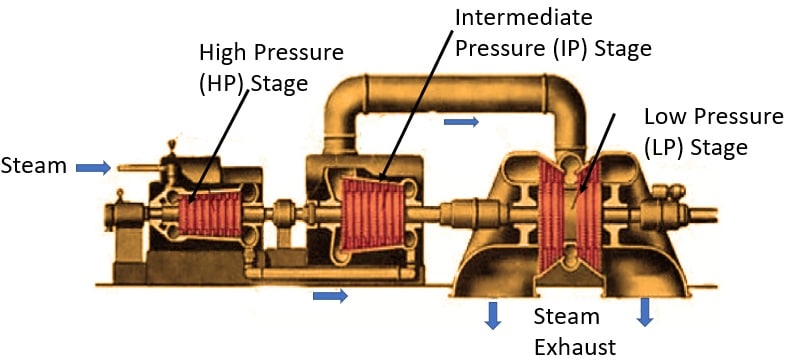
A marine steam turbine is a rotary prime mover that converts the thermal energy of high-pressure steam into mechanical rotational energy by expanding steam across rows of turbine blades.
Unlike reciprocating engines:
- Power delivery is continuous
- There are no pistons, connecting rods, or crankshafts
- Rotational speed is high and smooth
- Vibration levels are low
A steam turbine converts energy through velocity and pressure change, not through intermittent combustion events.
2. Why Steam Turbines Still Matter in Modern Shipping
Steam turbines persist because they solve specific marine engineering problems extremely well.
2.1 Enduring Power and Reliability
Steam turbines:
- Have very few moving parts
- Operate with uniform torque
- Experience minimal mechanical stress
- Can run continuously for months
This results in:
- Long service life
- Reduced vibration and noise
- High availability for mission-critical vessels
These characteristics make them ideal for:
- Aircraft carriers
- LNG carriers
- Turbo-generator systems
- Large auxiliary machinery
2.2 Fuel Adaptability and Decarbonisation Potential
The core strength of steam propulsion lies in fuel and heat-source flexibility.
Steam turbines do not burn fuel directly. They depend on steam generation, which allows:
- Oil-fired boilers
- Gas-fired boilers
- Boil-off gas (LNG) utilisation
- Biofuels and synthetic fuels
- Nuclear heat sources (naval vessels)
- Waste heat recovery
Changing the fuel does not require changing the turbine—only the heat source.
This positions steam systems as a future-compatible platform for decarbonisation.
3. Fundamental Operating Principle
Steam turbines operate on a simple but powerful concept:
- Steam is generated at high pressure and temperature in a boiler
- Steam expands through stationary nozzles, increasing velocity
- High-velocity steam strikes moving blades
- Momentum transfer causes rotor rotation
- Steam exits at lower pressure and temperature
The turbine extracts energy through:
- Change in steam velocity (impulse)
- Change in steam pressure (reaction)
- Or a combination of both
Impulse vs Reaction Turbines
| Feature | Impulse Turbine | Reaction Turbine |
|---|---|---|
| Pressure Drop Location | Occurs only in stationary nozzles | Occurs in both fixed and moving blades |
| Blade Channel Area | Constant cross-section | Varying cross-section |
| Blade Profile Type | Profile / bucket-type blades | Aerofoil-type blades |
| Steam Admission | Partial or restricted admission | Full (all-round) admission |
| Fixed Blade Function | Nozzles contained in diaphragm | Fixed blades act as guide vanes |
| Space Requirement | Occupies less space for same power | Occupies more space for same power |
| Efficiency Characteristics | High efficiency in initial (high-pressure) stages | High efficiency in final (low-pressure) stages |
| Typical Power Range | Small to moderate power | Medium to high power |
| Manufacturing Complexity | Simpler blade design, lower cost | More complex blade geometry, higher cost |
| Steam Velocity | High steam velocity | Lower steam velocity |
| Typical Marine Use | HP stages, control stages | LP stages, propulsion turbines |
Engineering Interpretation (What Actually Matters)
Impulse Turbines
- Extract energy primarily from kinetic energy
- Steam jets strike blades at high velocity
- Pressure remains nearly constant across moving blades
- Well suited for high-pressure, small volume steam
Impulse stages are ideal where pressure drop must be controlled precisely, such as initial stages of marine propulsion turbines.
Reaction Turbines
- Extract energy from both pressure drop and velocity change
- Moving blades act like aerofoils
- Continuous expansion through blade rows
- Require careful sealing and clearance control
Reaction stages excel in low-pressure, high-volume steam, making them ideal for LP sections of marine turbines.
4. Steam Propulsion System Architecture
Steam turbines are part of a complete thermal power plant, not standalone machines.
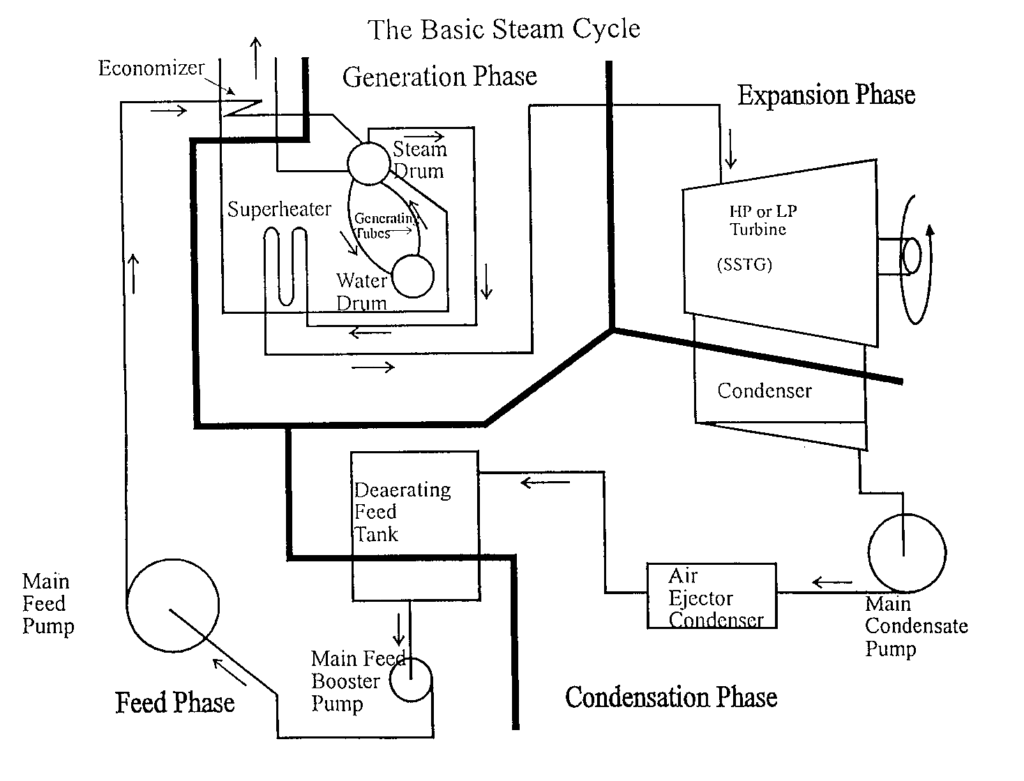
4.1 Typical Steam Propulsion Flow
- Fuel (or heat source) heats boiler water
- Superheated steam is produced
- Steam drives:
- Main propulsion turbine
- Turbo-generators
- Exhaust steam enters condenser
- Steam condenses back to water
- Condensate is treated and reused
This is a closed-loop Rankine cycle.
5. Steam Turbines in LNG Carriers
5.1 Why LNG Carriers Used Steam Propulsion
LNG cargo continuously evaporates, producing boil-off gas (BOG):
- ~0.1% of cargo volume (ballast)
- ~0.15% of cargo volume (laden)
Steam plants offered a natural solution:
- Burn BOG in boilers
- Generate steam
- Propel the ship and generate power
This made steam propulsion:
- Safe
- Efficient
- Cargo-compatible
The cargo itself becomes part of the energy system.
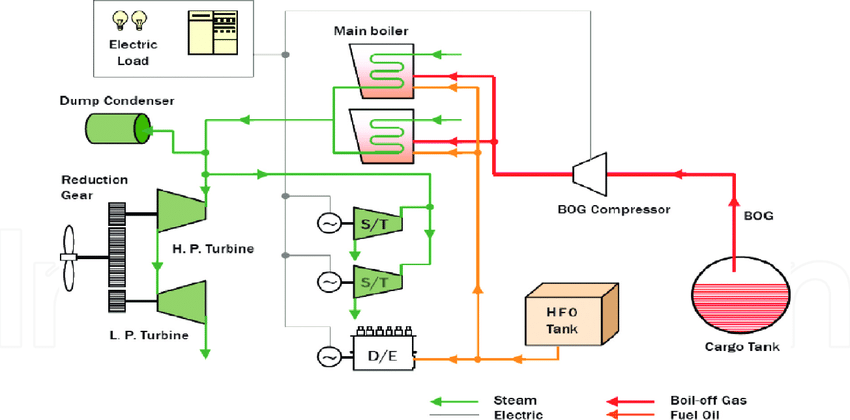
Most LNG carriers built pre-2015 used steam propulsion, with diesel generators as backup.
6. Types of Marine Steam Turbines
Steam turbines are classified by several criteria:
6.1 By Principle of Operation
- Impulse turbines – pressure drop in nozzles only
- Reaction turbines – pressure drop across fixed and moving blades
- Impulse-reaction turbines – combined approach (common in marine use)
6.2 By Steam Flow Direction
- Axial flow – steam parallel to shaft (most marine turbines)
- Radial flow – steam perpendicular to shaft (specialised use)
6.3 By Exhaust Condition
- Condensing turbines – exhaust steam condensed (propulsion, power generation)
- Back-pressure turbines – exhaust steam used for heating or processes
6.4 By Pressure & Casing Arrangement
- Single-stage / multi-stage
- Single casing
- Tandem compound
- Cross compound (HP and LP turbines on separate shafts)
7. Steam Flow, Staging & Power Control
Steam turbines control power output by:
- Regulating steam admission
- Adjusting nozzle opening
- Using multiple stages for efficiency
Multi-stage expansion:
- Reduces blade stress
- Improves thermal efficiency
- Allows large power extraction
Key difference vs diesel
Turbine power is controlled by steam flow, not fuel injection timing.
8. Condensing Systems & Closed-Loop Operation
Condensers:
- Convert exhaust steam back to water
- Create vacuum at turbine exhaust
- Increase turbine efficiency
Benefits of condensation:
- Higher thermal efficiency
- Reduced steam consumption
- Water conservation
Condenser performance directly affects turbine power and efficiency.
9. Mechanical Design & Reduction Gearing
Steam turbines operate at:
- Thousands of RPM (HP turbine)
- Hundreds of RPM (LP turbine)
Propellers require:
- ~80–120 RPM
This mismatch is handled by:
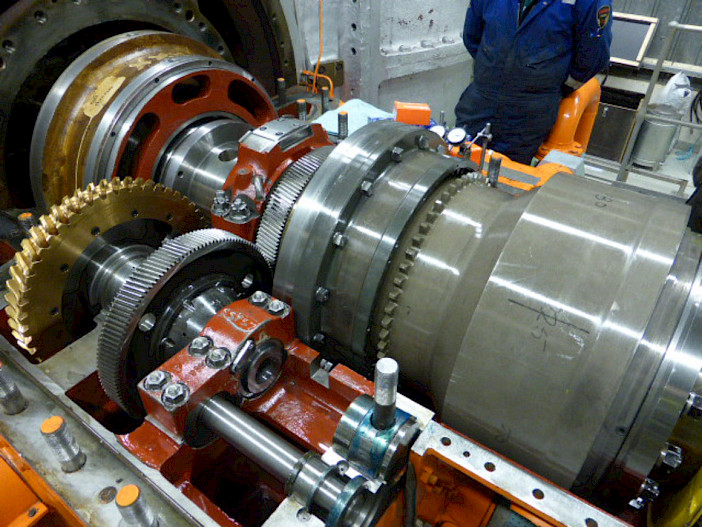
- Double-reduction gearboxes
- Tandem articulated gearing
- Double helical gears
Example (typical LNG carrier):
- HP turbine ≈ 4,800 RPM
- LP turbine ≈ 3,200 RPM
- Propeller ≈ 85 RPM
10. Control, Monitoring & Protection
Steam turbine plants monitor:
- Steam pressure and temperature
- Turbine speed
- Vibration
- Bearing temperatures
- Condenser vacuum
- Lubrication system health
Modern systems include:
- Digital monitoring
- Alarm trending
- Predictive maintenance tools
11. Operational Characteristics at Sea
Steam turbine plants:
- Prefer steady operation
- Have slow response compared to diesels
- Require skilled plant management
- Are highly stable once on load
Watchkeeping focus:
- Boiler water chemistry
- Steam quality
- Condenser vacuum
- Lubrication condition
12. Maintenance Philosophy & Reliability
Key maintenance priorities:
- Rigorous feedwater treatment
- Blade inspection for erosion
- Bearing and oil system care
- Condenser cleanliness
Steam turbines fail slowly and predictably when monitored correctly.
13. Steam Turbines vs Diesel & Gas Turbines
Steam Turbine vs Diesel Engine
- Diesels: higher part-load efficiency
- Steam turbines: smoother operation, fuel flexibility, high power
Steam Turbine vs Gas Turbine
- Gas turbines: rapid response, high power-to-weight
- Steam turbines: broader fuel compatibility, better steady-state efficiency
14. Modern Advancements in Marine Steam Turbines
14.1 Digital Twin Technology
- Virtual replicas for real-time monitoring
- Predictive maintenance
- Performance optimisation
14.2 Additive Manufacturing
- Complex blade geometries
- Improved aerodynamics
- Reduced material waste
14.3 Supercritical CO₂ (sCO₂) Turbines
- Compact, high-efficiency designs
- Higher thermal efficiency than steam
- Potential future marine applications
14.4 Waste Heat Recovery Integration
- Combined Gas & Steam (COGAS) systems
- Improved overall plant efficiency
- Reduced emissions
15. How This Page Anchors the Steam Systems Section
This page is the conceptual foundation for all steam-related content on MaritimeHub, including:
- Marine boilers
- Water treatment systems
- Condensers
- Turbo-generators
- LNG boil-off gas handling
- Steam plant faults and troubleshooting
A steam turbine is not obsolete—it is thermodynamically elegant, mechanically reliable, and strategically flexible.
When fuel diversity, power density, and reliability matter most, steam propulsion remains unmatched.
Tags
marine steam turbine · steam propulsion · LNG carrier propulsion · marine boilers · turbo generator · thermal power systems